Warehouse Floor Leveling in Amarillo, TX
Settled joints and rocking slabs punish forklifts, loads, and drivers on every pass. Injection leveling fixes the floor section by section while the building keeps running.
A warehouse floor is a machine component. Forklifts, pallet jacks, and order pickers are designed for flat, continuous concrete, and every deviation costs something: slower travel speeds over bad joints, shaken and damaged loads, accelerated wear on drive tires and steer axles, and operator fatigue from riding the same bumps hundreds of times a shift. When slab panels start moving under wheel loads, the joints spall, the bumps grow, and the maintenance line item compounds.
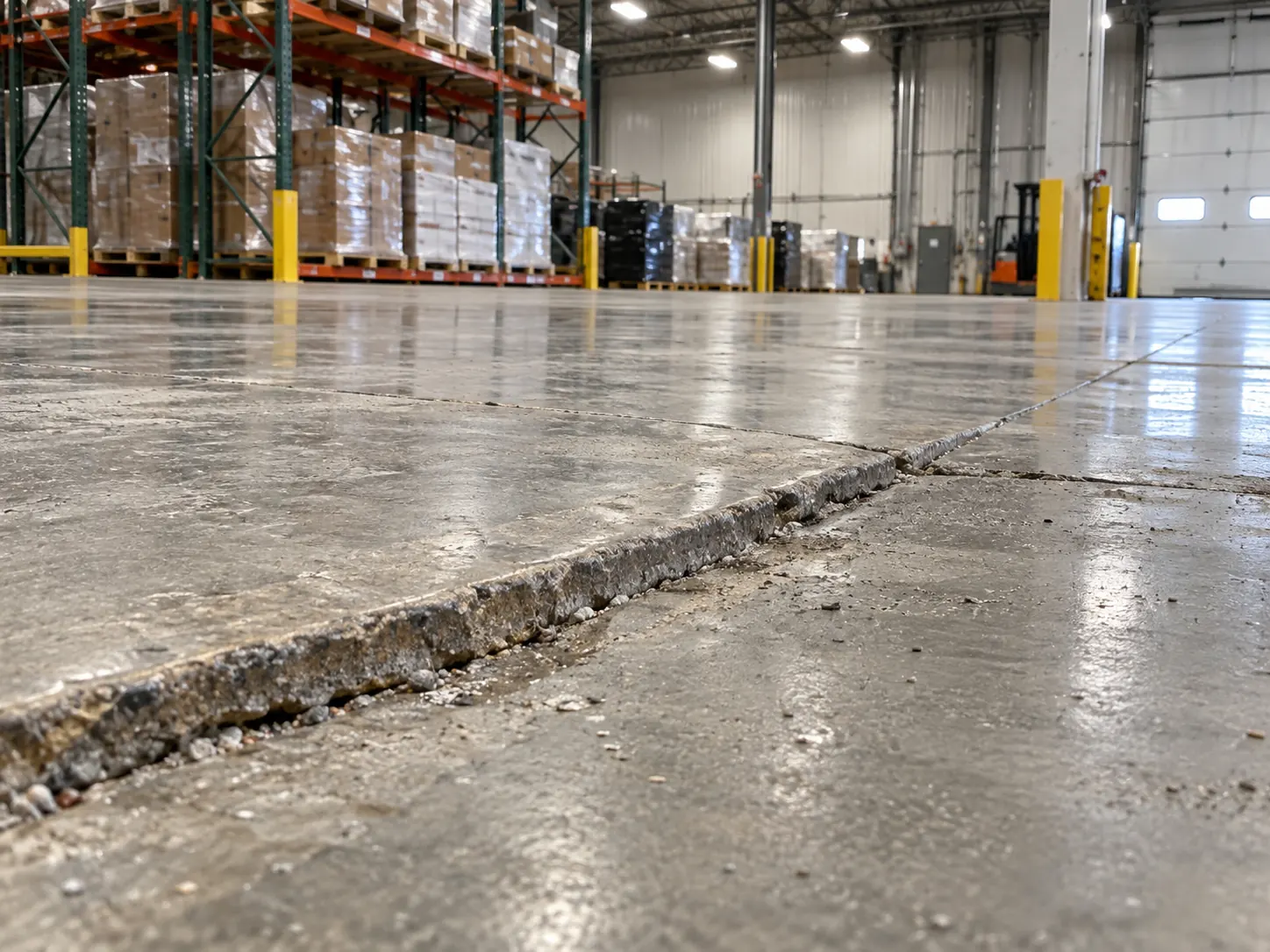
What Goes Wrong Under Warehouse Slabs
Warehouse floors in the Amarillo area are slab-on-grade over compacted base. The failures follow familiar patterns:
- Settled joints on travel lanes. Repeated wheel impacts consolidate the base at panel edges, the joint drops, and each pass hits harder than the last.
- Rocking panels. A slab that has lost base contact tips under load, clicking down on one side as the forklift crosses and back as it leaves.
- Voids from washout. Roof drain leaks, dock door weather intrusion, or under-slab plumbing failures wash fines out of the base, and the slab bridges the cavity until it cracks.
- Settlement under racking. Heavily loaded rack rows concentrate load onto base that was compacted for distributed traffic, and elevations drift out of tolerance.
- Transitions out of tolerance. Floor-to-dock and floor-to-ramp transitions settle differently than the field of the floor, creating thresholds where smoothness matters most.
How Warehouse Floors Are Leveled
The repair is polyurethane injection in nearly every case. Dime-sized ports go through the slab at the settled joints or over the voids, structural foam is injected in controlled lifts, and elevations are checked against benchmarks as the panels come back into plane. Where panels rock but have not dropped, low-volume injection restores full base contact without lifting, which is slab stabilization, and where cavities exist the work starts with void filling.
Cure speed is the operational point: polyurethane lifting can significantly reduce downtime compared with slab replacement, and work can often be phased around operating schedules. Cement slurry, with its longer curing period and far greater weight, is usually a poor fit inside a working building.
Working Around a Live Operation
Warehouse leveling is planned like maintenance, not construction. Problem joints are mapped during a walk-through, work is sequenced by aisle or zone, and each zone needs only a few hours clear of traffic. Nights and weekends cover the lanes that never stop. Racking normally stays in place: injection ports need the slab surface, not the airspace above it, so work proceeds in aisles alongside loaded racks with appropriate care around baseplates.
Warehouse Floor Questions
Can the floor be leveled while the facility stays operational?
Usually. Work can often be phased by zone so parts of the building stay in use, with each zone out of service for a short window rather than days. Exact return-to-service timing depends on the repair system and loading.
Can polyurethane support loaded racking and forklift traffic?
Commercial lifting foams are available in different strengths and densities for heavily loaded slabs. Rack post loads, forklift traffic, machinery, and other concentrated loads should be evaluated as part of the repair design, with the material specified from the product data sheet.
How long before forklifts can run on a lifted section?
Polyurethane lifting materials are designed to cure quickly, but the exact time before forklift or other heavy traffic can resume depends on the product, slab, load, and installer specifications.
Do settled joints really damage equipment?
Ask your forklift maintenance history. Joint impacts show up as drive tire wear, wheel bearing and axle issues, and rattled masts, and operators slow down to protect loads, which cuts throughput. Fixing the joints is usually cheaper than a year of absorbing those costs.
Keep the Forklifts Moving
Call (806) 513-5505 to discuss the affected floor areas, traffic requirements, and operating schedule. You can also request service online if you prefer.