Concrete Void Filling in Amarillo, TX
Fill the empty space under a slab before the concrete cracks, drops, or breaks through. Void filling restores support without waiting for visible failure.
A void is a pocket of empty space between the bottom of a concrete slab and the soil that is supposed to hold it up. Concrete has excellent compressive strength but poor bending strength, so a slab spanning a cavity is living on borrowed time. It carries loads by bridging, and every vehicle, forklift, or footstep flexes it a little until it cracks and drops into the gap.
Void filling is the repair that happens before that failure, or alongside a lift when the slab has already moved. Material is injected through small ports to occupy the cavity and give the slab continuous support again.
What Happens When There Is a Void Under a Slab?
At first, usually nothing you can see. The slab bridges the gap and looks fine from above. Then the signs start: the concrete sounds hollow when tapped or driven over, hairline cracks appear over the unsupported area, a corner starts to rock, or soil visibly washes out along an edge after rain. Left alone, the ending is predictable. The slab settles into the void or punches through it, and a fill-only repair becomes a lift or a replacement.
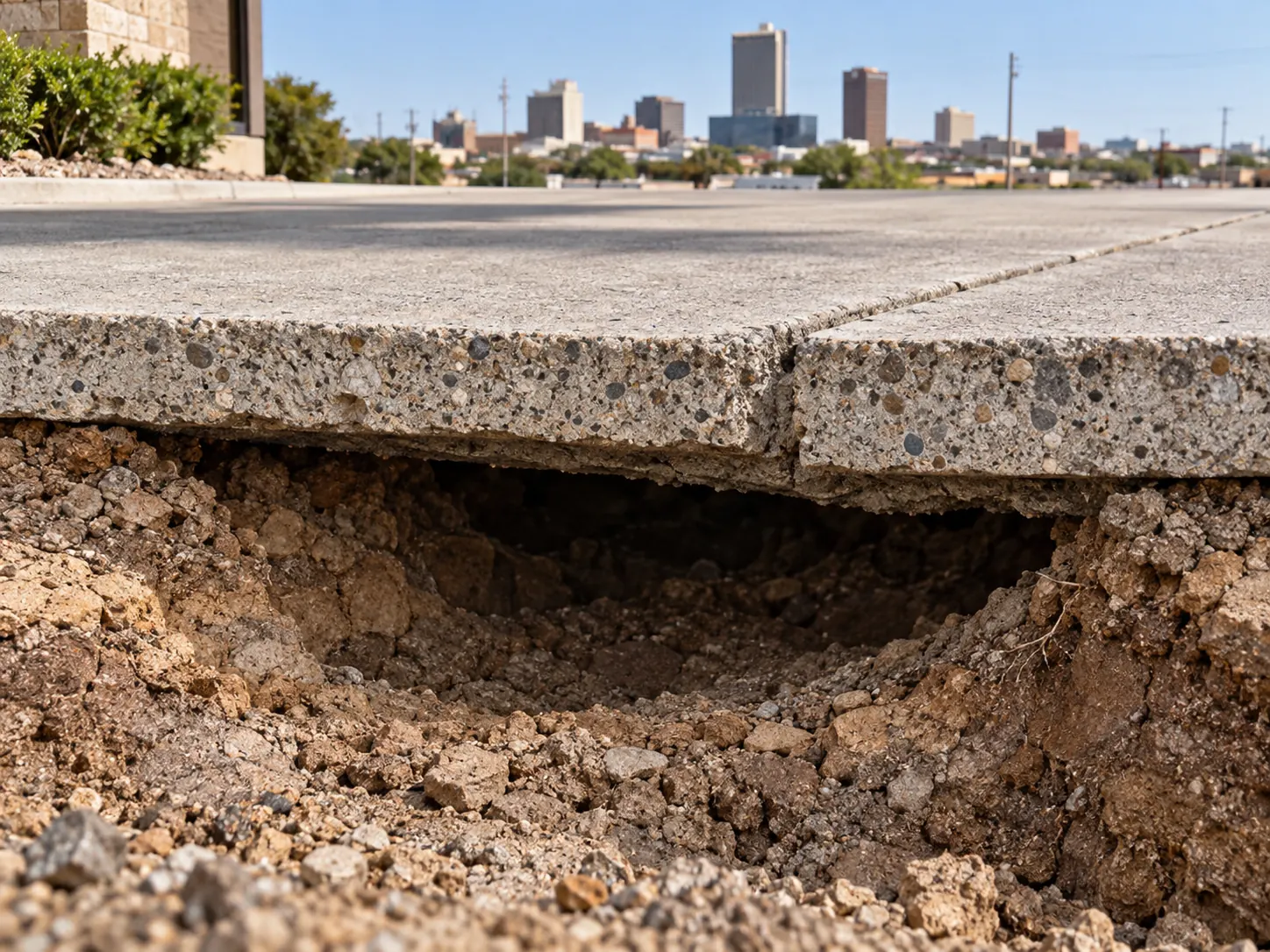
Water moving under a slab carries soil with it, leaving a growing cavity.
What Causes Voids Under Concrete in Amarillo?
Most voids around Amarillo trace back to water or poor compaction. Downspouts dumping at a slab edge, irrigation overspray, or a plumbing leak can wash fines out from under concrete a little at a time. Clay soils in the Panhandle also shrink during long dry spells, pulling away from the slab bottom and leaving a gap that never closes back up evenly. And fill dirt that was not compacted properly during construction keeps consolidating for years, settling away from the slab above it. The voids explainer and soil settlement page go deeper on each cause.
How Void Filling Works
The process mirrors concrete lifting, with a different goal. Small ports are drilled through the slab over the cavity. Expanding polyurethane foam, or in some large-volume cases a flowable grout, is injected until the void is occupied and the material makes firm contact with the slab bottom. If the slab has also settled, injection continues and becomes a lift. If the slab is still at grade, the fill simply locks in support, which is the essence of slab stabilization.
Polyurethane is particularly suited to void work because it expands to seek out the edges of a cavity, sets in minutes, resists water, and adds almost no weight to soil that may already be unstable.
Void Filling Questions
How do I know if there is a void under my concrete?
The common clues are a hollow or drummy sound when the slab is tapped or driven across, new cracks with no visible settlement, a slab corner that moves underfoot, and soil or sediment washing out at the edges after storms. A physical inspection can confirm it; in some cases a small test hole or probe tells the story quickly.
Can a void be filled without lifting the slab?
Yes. If the slab is still at the correct height, injection is stopped once the cavity is full and the material contacts the slab bottom. Nothing moves; the slab just regains support. That is the ideal time to catch the problem, before settlement adds a lift to the scope.
What gets injected into the void?
Most residential and commercial void work uses two-part expanding polyurethane foam. Very large cavities, like those under failing culverts or big exterior slabs, are sometimes filled with a cementitious flowable grout for material-cost reasons. The assessment determines which fits.
Will filling the void stop the washout from coming back?
The fill itself will not fix bad drainage. Closed-cell foam resists future water movement better than soil or slurry, but if a downspout keeps discharging at the slab edge, water will keep working on the surrounding soil. Redirecting the water is part of any lasting repair, and it is usually the cheapest part.
Think There Is a Void Under Your Concrete?
Hollow sounds, new cracks, or soil washing out at the slab edge are worth checking early. Call (806) 513-5505 to discuss it, or request service online.