Sunken and Uneven Concrete in Amarillo, TX
How to read what a settling slab is telling you, what happens if you wait, and which repair fits each stage.
Uneven concrete is a progress report from the soil underneath. A slab does not sink on its own; it follows ground that is compressing, shrinking, or washing away below it. That means the surface symptoms, the offsets, tilts, and cracks you can see, map fairly reliably to what is happening below, and reading them right tells you how urgent the repair is.
What Does Settling Concrete Look Like?
The early signs are easy to dismiss and worth catching:
- Joint offsets. One panel sits lower than its neighbor. On walkways this is the classic trip edge; on driveways you feel it in the car.
- Tilt. A slab rotates as one edge settles. Water that used to run off toward the yard now runs toward the house.
- Growing gaps. A dark gap opens under a slab edge, between a porch and the house, or between a garage floor and the stem wall.
- New cracks. A crack that appears and then widens month over month means the slab is flexing over ground that is no longer supporting it evenly.
- Hollow sounds. A drummy note underfoot or under tires means the slab has separated from its base even if nothing has visibly moved yet.
- Doors and thresholds. A garage door that no longer seals or a step-down at an entry that used to be flush.
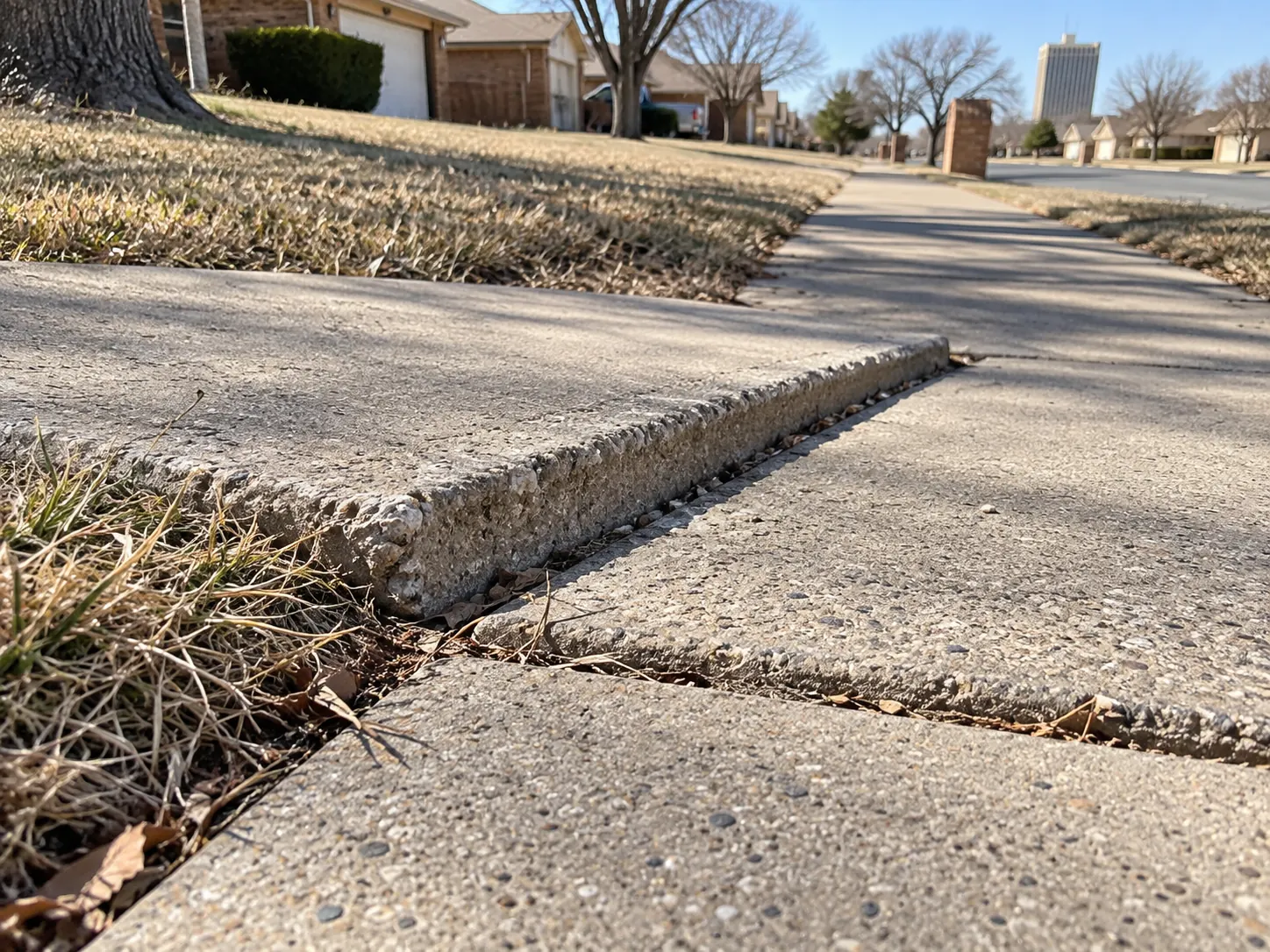
Is Uneven Concrete Actually a Problem, or Just Ugly?
Both, in stages. The direct risks are real: trip falls on offset joints are among the most common injury claims for both homeowners and property managers, and a half-inch edge is enough. The indirect risks cost more. A tilted slab that drains toward the house feeds water into the foundation soil, and in Panhandle clay that drives the shrink-swell movement that damages foundations. And a slab bridging a void is quietly accumulating stress until it cracks, at which point a lift becomes a lift plus crack repair, or a replacement.
Waiting has a price curve. Settlement caught at the hollow-sound stage costs the least to fix, an offset costs more, and a shattered slab costs the most. Nothing about Amarillo weather pushes the curve the other direction.
Why Is This So Common in Amarillo?
Short version: clay soils that change volume with moisture, a semi-arid climate that swings between drought and downpour, and freeze-thaw winters. Slabs here sit on ground that shrinks in dry months, swells after storms, and erodes where roof and irrigation water concentrate. The long version, with the local soil and climate specifics, is on why concrete sinks in Amarillo.
Which Repair Fits Which Stage?
| What you see | What is happening below | The usual fix |
|---|---|---|
| Hollow sound, no movement | Void or loose base under a slab still at grade | Slab stabilization or void filling |
| Offset joint, tilted panel | Base settled or washed under part of the slab | Concrete lifting by foam or slurry |
| Cracked panel, sections dropped | Slab broke while bridging unsupported ground | Lift the sections and re-support; seal the cracks |
| Shattered, crumbling surface | The concrete itself has failed | Replacement, honestly |
What Should You Do First?
Two things, in order. Kill the water source if there is one: extend the downspout, redirect the sprinkler head, clear the drain. It costs almost nothing and slows the settlement immediately. Then get the slab assessed while it is still liftable. Photos of the offsets, the gaps, and any washout at the edges are enough to start a service request, and an assessment turns guesswork into a scoped repair.
Caught It Early? Good. Act Early Too.
Concrete settlement rarely improves on its own once support beneath the slab has been lost. Call (806) 513-5505 to discuss what your concrete is doing, or request service online.