Polyjacking in Amarillo, TX
Polyurethane foam injection lifts settled concrete through dime-sized holes, cures in minutes, and adds almost no weight to the soil below.
Polyjacking goes by several names: polyurethane concrete lifting, foam jacking, poly leveling, foam injection. They all describe the same repair. Two liquid components are pumped through a small port in the slab, they react and expand into rigid structural foam, and the expansion lifts the concrete back toward its original position.
For most residential projects in Amarillo, and for nearly all interior and commercial work, polyjacking has become the default recommendation. The reasons are practical, not promotional, and they are laid out below.
How Does Polyurethane Concrete Lifting Work?
The crew drills ports about five eighths of an inch across, roughly the size of a dime, through the settled slab. An injection gun seats into each port and delivers the two-part polyurethane. Within seconds the mixture expands to many times its liquid volume, filling voids first and then generating lift as the foam presses against the underside of the slab.
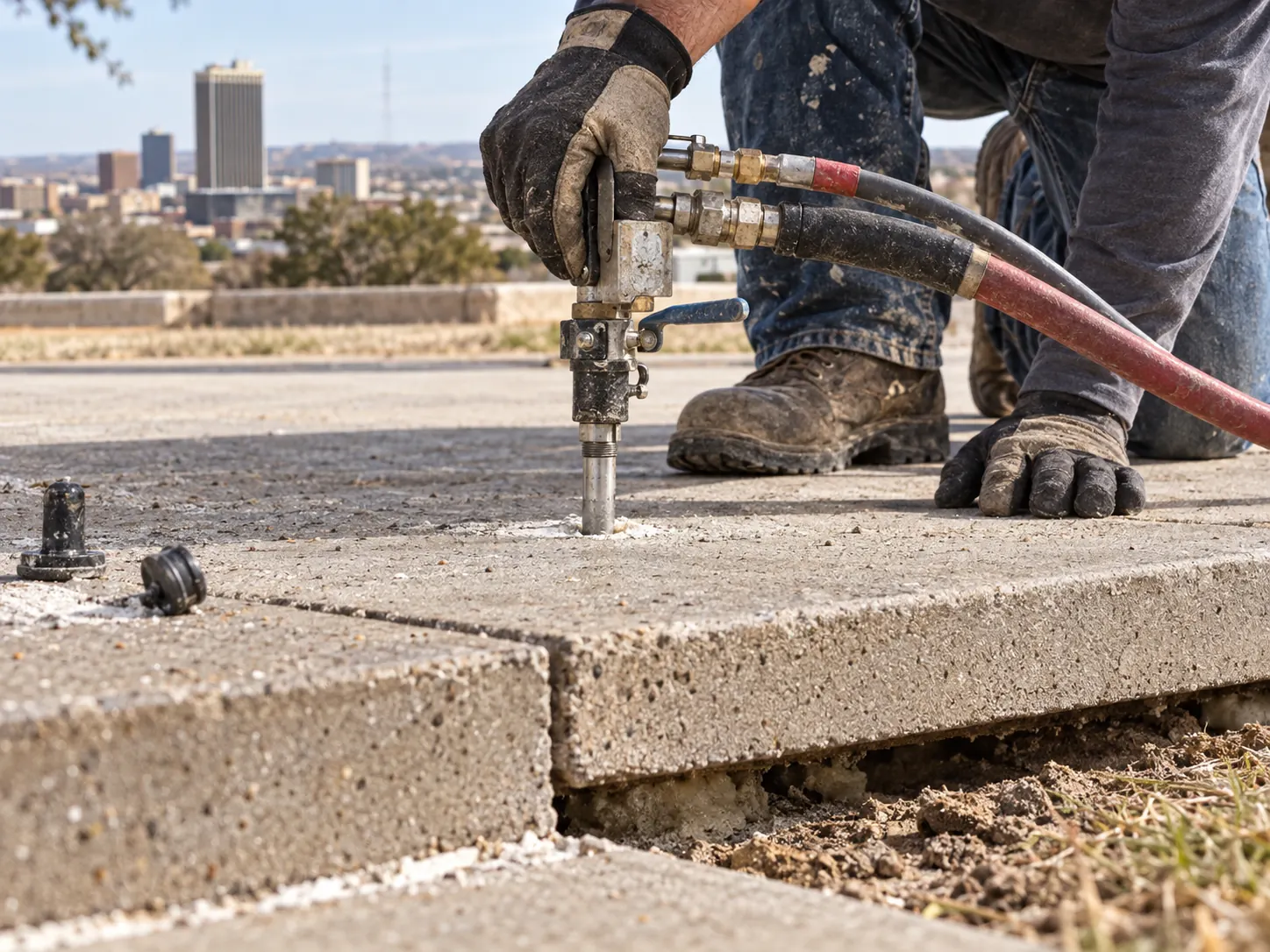
Polyurethane lifting foams are designed to cure quickly after injection. Cure rates vary by formulation and manufacturer, which is one reason return-to-service instructions should come from the installer. The quick set is what drives most of polyjacking's advantages: elevations can be checked and adjusted during the lift rather than a day later.
Why Choose Foam Over Other Methods?
- Small holes. Dime-sized ports patch cleanly and are hard to spot afterward. Mudjacking holes are two to three times larger.
- Light weight. Cured polyurethane foam is substantially lighter than cement-based slurry, though exact density varies by product. On soil that already failed once, added weight is the last thing you want.
- Fast return to use. Often allows a faster return to use than new concrete.
- Water resistance. Closed-cell foam does not absorb water or wash out, which matters where washout caused the settlement in the first place.
- Reach. Expanding foam flows into voids and compacts loose soil beyond the injection point, so it can treat cavities under the slab while it lifts.
Mudjacking still has its place, mostly on large exterior slabs where material cost dominates and weight matters less. The side-by-side comparison covers when each one wins.
What Can Polyjacking Fix?
Around Amarillo the common polyjacking projects are settled driveways, offset sidewalk panels, tilted patios, dropped garage floors, uneven pool decks, and sunken porch slabs. On the commercial side, foam handles warehouse floors, dock aprons, and machine-area slabs where downtime is expensive and heavy fill is unacceptable.
A Note on Branded Foam Systems
Some national companies market polyurethane lifting under trademarked product names. Those are brand names for the same category of repair: two-part expanding polyurethane injected beneath a slab. This site uses the generic terms, polyjacking and polyurethane foam injection, because the chemistry and the process are what matter, not the label on the drum.
Polyjacking Questions
How much weight can polyurethane foam support?
Structural lifting foams are available in different densities and compressive strengths for residential and commercial applications. The load spreads across the foam bed rather than a single point. The correct material depends on the slab, underlying conditions, and expected loading, so the specification should come from the installer and the product data sheet.
Is the foam safe for soil and landscaping?
Cured polyurethane is inert and stable. It does not leach into soil or affect nearby plants, and because it sets within minutes it does not migrate into places it should not go. It is the same general chemistry used under roadways and airport slabs.
Does polyjacking work in an Amarillo winter?
Yes. The foam cures by chemical reaction rather than evaporation, so cold air does not stop it. Crews work through Panhandle winters, though a hard freeze that leaves ice under the slab can push a project back a few days.
Can foam injection fill a void without lifting the slab?
Yes. Injection can be run at lower volume to fill empty space and support a slab in its current position. That is the core of void filling and slab stabilization, and it is common on slabs that sound hollow but have not visibly dropped.
How many holes will be drilled?
It depends on slab size and how the settlement is distributed. A single sidewalk panel might need two or three ports. A driveway section typically takes four to eight. Ports are spaced so foam coverage overlaps and the lift stays even.
Ask About Polyjacking for Your Slab
Call (806) 513-5505 to discuss what the concrete is doing and whether foam lifting fits the project, or request service online.