Loading Dock Concrete Leveling in Amarillo, TX
Every trailer that backs into a settled dock apron hits it harder than the last one. Leveling stops the pounding cycle and restores smooth, draining approaches.
Dock aprons and approach slabs take the most abusive loading on a commercial property: 40,000 pound trailers backing over the same wheel paths dozens of times a day, landing gear dropped on concentrated points, and yard trucks turning under load. The soil under an apron compacts and washes at the building edge, the slab settles, and a feedback loop starts. Once the apron sits low, every trailer impact lands as a blow instead of a roll, which settles it faster.
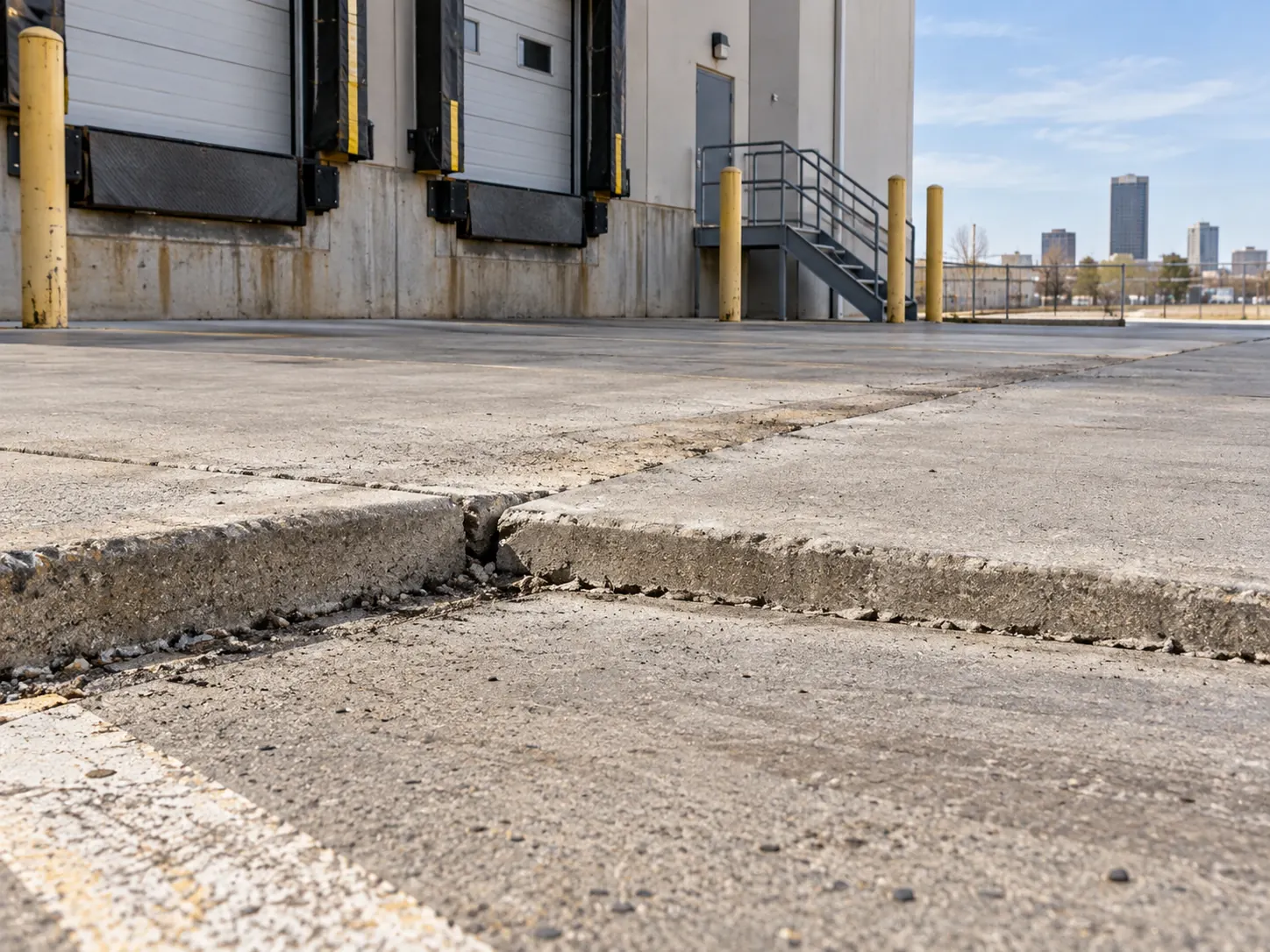
Dock Problems Leveling Corrects
- Settled aprons that drop trailer beds below dock height, fighting the leveler on every load
- Broken approach panels in the drive lanes where axle loads concentrate
- Ramp transitions that have separated, jolting pallet jacks and slowing every trip
- Threshold offsets at the dock door line where forklifts cross between building slab and dock plate
- Negative drainage, aprons tilted back toward the building, ponding water at the foundation and dock pit
- Voids under aprons where downspouts and pit drainage have washed the base out
How Dock Aprons Get Lifted
The repair follows the standard injection process with dock-specific judgment. Ports are drilled through the apron over the settled zones, and structural polyurethane foam is injected in staged lifts, wheel path by wheel path, until the apron meets the dock at grade again and slopes away from the building. Density is chosen for repeated axle loading. Where the apron has cracked into sections, each section is raised and re-supported so the pieces work as a surface again. Voids found along the building line are filled as part of the same mobilization, which is commercial void filling in miniature.
Cure speed matters at a dock. Polyurethane lifting can reduce downtime compared with replacement, which is especially important where dock positions need to remain available. Slurry-based methods generally require more curing time and may be less attractive where minimizing downtime is the priority.
Drainage: The Half of the Fix That Costs Nothing
Almost every settled apron has a water story. Downspouts discharging beside the pit, a clogged trench drain, or an apron that already tilts toward the building and holds water against its own base. The lift restores positive slope, and the site fix, extending the downspout, clearing the drain, keeps the new slope working. Skip the water fix and the settlement clock restarts.
Loading Dock Questions
How long is a dock position out of service?
Project duration depends on the number of affected positions, lift size, access, and repair method. Multi-position docks can often be phased so only part of the loading area is unavailable at one time.
Can foam stand up to trailer landing gear and axle loads?
Yes, with the right density specified. The cured foam bed spreads loads across the base rather than concentrating them, and the same class of material undersealed highway slabs long before it reached docks. Landing gear point loads are noted in the lift plan.
Our apron is cracked in several places. Lift or replace?
Cracked into a handful of large sections: usually liftable, and the sections get re-supported so they stop moving independently. Crushed into small rubble in the wheel paths: that zone is a candidate for replacement, often with injection stabilizing the surrounding intact slabs so the new pour and old apron behave together. An on-site look settles it quickly.
Why does the apron settle at the building edge first?
The soil beside a foundation is backfill, looser than the ground the rest of the apron sits on, and roof water tends to concentrate at exactly that line. Add trailer impact loading and the building edge settles first almost every time. It is the same mechanism that sinks residential garage-side driveway slabs, at ten times the load.
Fix the Dock Before It Fixes a Trailer
Call (806) 513-5505 to discuss the affected dock positions and scheduling needs, or request service online if you prefer.