Commercial Concrete Leveling in Amarillo, TX
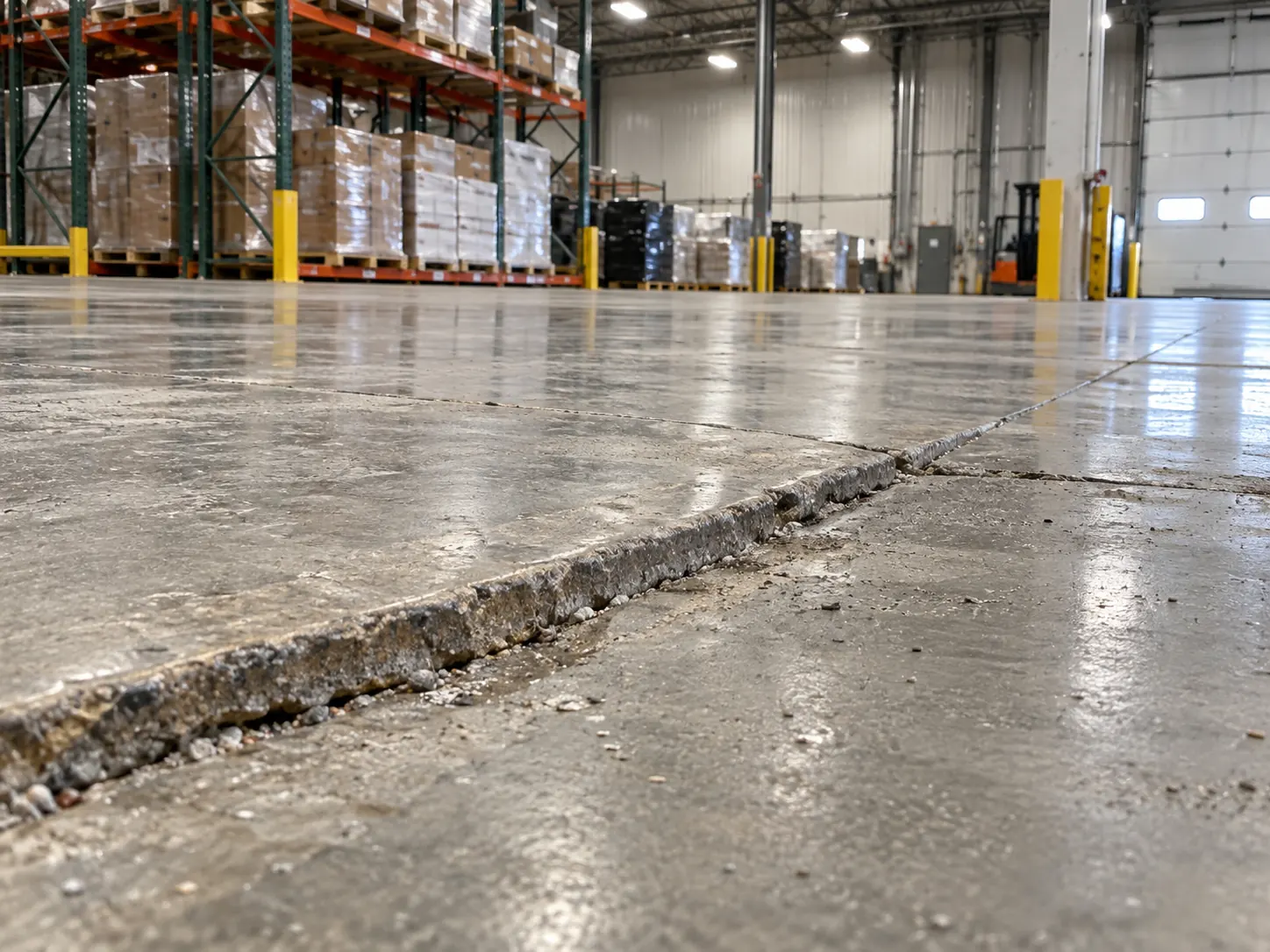
Settled slabs slow forklifts, generate trip claims, and pound themselves apart under truck traffic. Leveling fixes the concrete without shutting the facility down.
Commercial concrete failure is a money problem before it is a concrete problem. A dropped joint in a distribution aisle slows every forklift pass and shakes loads. An offset walkway panel in front of a retail entrance is a documented liability the day someone photographs it. A settled dock apron takes a hammer blow from every trailer that backs in. None of these get better on their own, and full replacement means demolition, cure time, and shutting down the exact area that earns the money.
Concrete leveling exists for this situation. The slab is raised and re-supported from below through small drilled ports, repairs can often be completed in sections with far less disruption than slab replacement, and polyurethane systems may allow a relatively fast return to service. Most commercial projects are scheduled in phases, off-shifts, or overnight so operations continue around the work.
Where Commercial Leveling Applies
Amarillo's commercial concrete lives hard. Distribution buildings along I-40, feed and ag operations, manufacturing shops, retail centers, offices, and hundreds of apartment communities all sit on slab-on-grade concrete over Panhandle soils that shrink, swell, and wash. The applications below each have a dedicated page:
- Warehouse floor leveling: settled joints, rocking panels, forklift routes
- Industrial and manufacturing floors: machine areas, heavy loads, shop slabs
- Loading docks and dock aprons: approach slabs, ramps, thresholds
- Concrete parking areas: settled panels, drainage correction, drive lanes
- Commercial sidewalks and walkways: trip hazards, accessibility, entrances
- Commercial void filling: cavities under slabs, washout, undersealing
- Apartment and HOA properties: walkways, drives, pool decks, budgets
Why Facilities Choose Leveling Over Replacement
| Concern | Leveling | Replacement |
|---|---|---|
| Downtime | Typically phased by section around operations | Days to weeks per section, area closed through cure |
| Traffic return | Often rapid with polyurethane systems | Requires curing before normal use; timing depends on mix and loading |
| Cost | Generally lower than full replacement | Demolition, haul-off, base prep, new pour |
| Disruption | Small ports, no debris, no wet concrete | Saw cutting, breakers, truck access through the site |
| Root cause | Fills voids and stabilizes the base | New slab over the same failed base unless re-engineered |
That last row deserves emphasis. Replacing a slab that settled because of voids or washout puts new concrete over the same failed ground. Injection leveling treats the base as part of the repair.
Trip Hazards, Accessibility, and Liability
For property managers, walkway offsets are the recurring headache. Accessibility guidance treats vertical changes over a quarter inch as needing treatment, and premises liability claims rarely go well when a photographed offset sat unrepaired for months. Leveling handles offsets panel by panel at a cost that fits maintenance budgets rather than capital budgets, which is why walkway programs at apartment communities and HOAs are a steady part of commercial work here.
How Commercial Projects Run
- Walk-through and elevations Problem slabs are mapped, elevations shot, and causes identified: washout, fill settlement, joint pumping, or drainage.
- Scope and phasing The repair plan works around your operation: sections, shifts, and traffic routing agreed up front.
- Injection work Ports drilled, slabs lifted or stabilized in controlled stages, elevations verified against fixed benchmarks.
- Return to service Ports patched and the area cleaned, with polyurethane-lifted slabs often back in use much sooner than replacement concrete would allow.
Commercial Leveling Questions
Can leveling work be done without closing the business?
Usually. Work can often be phased by section so parts of the property remain available during the project. Exact return-to-service timing depends on the repair system and loading. Overnight and weekend scheduling handles areas that cannot close during business hours, like entrances and drive lanes.
Does polyurethane handle commercial floor loads?
Structural lifting foams are available in a range of densities and compressive strengths, and the load spreads across the foam bed rather than a single point. The correct material depends on the slab, base conditions, and expected loading, so racking, forklift, and truck loads should be evaluated as part of the repair design.
Who typically requests commercial leveling in Amarillo?
Facility managers, property management companies, HOA boards, warehouse and logistics operators, retail and office landlords, school and church facilities staff, and general contractors handling tenant improvements. Requests usually start with one problem area and grow into a property-wide walk-through.
Can you provide documentation for our records?
Assessment findings, the repair scope, and before-and-after elevation notes can be documented for maintenance files and liability records. Tell us what your process needs when you request service.
Commercial Slab Problems Do Not Wait
Call (806) 513-5505 to discuss the affected slabs, access requirements, and operating schedule. You can also request service online if you prefer.